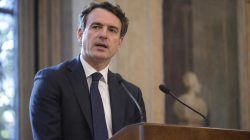
UK GOV.UK published a speech delivered by Scottish Secretary Douglas Alexander at the Pontignano Conference in Rome on 27 November 2026.
Alexander opened by describing his pleasure at attending the conference and acknowledged host Stephen Hickey, the British Council and co-chairs Lord Willetts and Alessandro Cattaneo for bringing participants together.
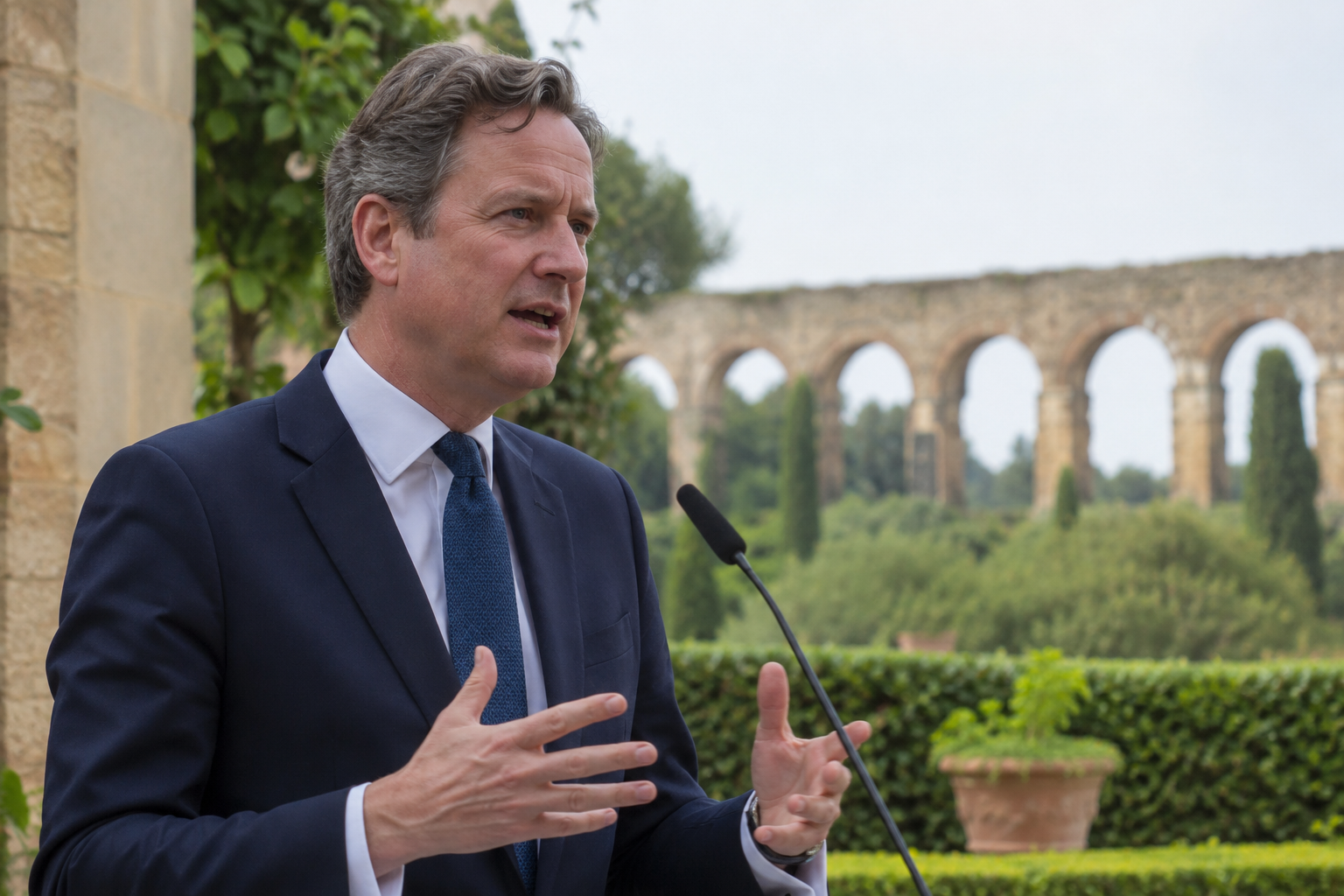
Referring to the thirty-six arches of a Roman aqueduct in the garden outside, built almost two thousand years ago to transport water over long distances, Alexander said he wanted the same spirit of connection to inform the conference. He added that, as a Scot, he felt that connection particularly strongly in Italy.
He noted that Glasgow University was modelled on Bologna and that Italian families, many from Barga, established cafés, chip shops, restaurants and ice cream parlours in Scotland. He expressed gratitude for the resulting improvement in Scottish cuisine. He also cited the Italian Chapel in Orkney, which Italian prisoners of war created as a place of beauty during wartime.
Alexander said Scotland’s connections extended across Europe. He observed that the founder of modern Scots law wrote much of his major work while exiled in Leiden, while Adam Smith began The Wealth of Nations during his time in France. France is now the largest market for Scottish salmon, he said. He also recalled that Polish soldiers who defended Scotland’s coast against fascism in the 1940s remained and built lives there, and that Scotland produced around a fifth of the world’s ships on the River Clyde at the industry’s height, carrying trade to Europe and farther afield.
In Alexander’s account, Scotland achieved greatness through building bridges, rather than walls.
He recalled giving a lecture at the European Studies Centre in Oxford ten years earlier that month, when he identified himself as Scottish, British and European and said he saw no need to choose among those identities. He described himself then as a rooted internationalist and said that remained his position.
Alexander set out three arguments. The first was that the previous decade had been defined by divergence in both domestic politics and the international order. The second was that great power rivalry was already under way and would largely shape international affairs during the coming decade. The third was that interdependence, rather than independence, offered the answer for Scotland and the whole of Britain, through a politics intended to restore people’s control by restoring their prospects for the future.
Before considering what lay ahead, he invited the audience to reflect on recent history.
Alexander characterised most of his lifetime as a period of European convergence. Following 1945, he said, countries that had twice devastated one another during the previous century joined themselves through the rule of law, supported by and supporting economic and later technological convergence. Capital, goods, services, ideas and data subsequently crossed borders with increasing speed.
He argued that the past decade had interrupted this trend, replacing decades of convergence with divergence as the world grew more polarised, regionalised and protectionist. Most significantly for the conference, he noted that ten years earlier the United Kingdom had voted to leave the European Union.
Alexander recalled watching the referendum results with his family in Scotland late into the night. Sunderland’s declaration shortly after midnight gave him a sinking sense that the result was real, he said. By morning, all 32 of Scotland’s local council areas had voted to remain in the European Union. He described his response as sadness rather than anger—not sadness for an institution in Brussels, citing his former boss Tony Blair’s observation that affection for the European Union was inversely related to contact with its institutions, but sadness about lost economic opportunities and his fear that young people would have fewer opportunities than his generation had enjoyed.
Looking back, Alexander argued that Britain and Europe separated because politics itself had fractured. He identified three forces behind that rupture across multiple countries. The first was economic anger after a decade of stagnant wages in which the benefits of globalisation went to relatively few people; in his formulation, weak economics produces angry politics. The second was political alienation following a financial crash that damaged trust in powerful institutions and in the longstanding expectation that children would become better off than their parents. The third, alongside economic anxiety and political alienation, was cultural anxiety among people who felt their surroundings no longer resembled the country they had known.
According to Alexander, divergence in the international order reflected the simultaneous breakdown of domestic economics and politics.
He said many Leave voters were exhausted by their circumstances and were asking fundamentally human questions about why hard work did not enable them to progress, who would help with rising bills, why others seemed to receive support when they did not and whether their children would have a better future. Alexander said those were the correct questions, although he disagreed with the answer chosen.
A decade later, he argued, the world was more uncertain and dangerous, contrary to Brexiteers’ claims at the time. Great power rivalry was not a remote possibility but a current reality that would partly define the next decade, he said.
Looking towards the middle of the century, Alexander cited Tony Blair’s description of a world dominated by three giants—the US, China and India—whose status would derive from the scale of their populations. At the same time, he said, global trade was fragmenting into large blocs.
He said geopolitical, geoeconomic and technological shocks were changing the international order, with networks of economic interdependence increasingly being used as instruments in great power rivalry. Alongside conventional state power, Alexander said AI and technology were also producing a simultaneous, substantial concentration of power among a small group of highly influential companies.
Rather than reaching ‘The End of History’, Alexander said the world was experiencing history-making events. He described Russia’s invasion of Ukraine as barbaric and said it had brought Europe its deadliest war since 1945. Russian sabotage, cyber-attacks and disinformation were threatening undersea cables, power grids and elections, he said, while American allies were justifiably asking Europe to assume more responsibility for its defence. Citing the late Sir Alex Younger, the former Chief of MI6, Alexander said the world was moving from Helsinki to Yalta—from rules and cooperation towards a system in which great powers make the decisions.
Alexander said that contrast had been visible the previous week in two summits. In Shenzhen, almost 6,000 miles from Rome, the leaders of America, China and Russia had gathered around one table. He described them as two superpowers and one former superpower deliberately invoking the imagery of Yalta. One day later, Britain and the European Union met in Brussels as partners.
He argued that the two images offered a view of an emerging world in which scale determines who has a voice. Together, he said, they raised a question that every European country must answer: how to accumulate and project power during the coming decades.
Alexander said he would return shortly to the issue of how that future could be influenced.
First, he argued that much of the politics underpinning the previous decade had focused on the past rather than the future, using nostalgia and a desire to recover control. He pointed to the slogan that won the 2016 referendum, take back control, and said its most significant word was “back”. In his analysis, it offered a preferable past rather than a better future and represented restoration instead of transformation. Alexander said people were right to seek greater control over their lives and acknowledged Brexit as a democratic decision that he respected, while maintaining that respect for the vote did not require denying its costs or consequences.
Alexander said the promised benefits had not materialised. He cited credible independent estimates suggesting that the economy would be between 4 and 8 percent smaller than it would otherwise have been. Food and drink exports to the EU were down by almost a quarter in real terms, he said, while too many overlooked towns still awaited recognition.
He also addressed the promise of “Global Britain.” Alexander said the public had been told that cutting ties with neighbouring countries would increase Britain’s standing in capitals around the world, but argued that this had not happened. The Channel remained 21 miles wide, he noted, and he characterised the belief that agreements elsewhere in the world could compensate for departure from the deepest free trade area of which Britain had been part as a post-imperial fiction. For a decade, he said, Britain had resembled a cork carried by historical tides when it should have helped direct them.
Brexit was now a lived reality rather than an abstract proposition or collection of impossible promises, Alexander said, and in his view it had failed even by its own standards. He presented the current choice as one between accepting a diminished status quo and changing it by giving people greater power, control and hope for a better future. Achieving that change, he argued, required strengthening the country internationally and, critically, domestically.
Alexander said the agreement reached in Brussels the previous week should be treated as a foundation and proof of concept, rather than the limit of the government’s ambitions. He repeated the Prime Minister’s statement that there would be no “banging on about Europe”, adding that this would be left to people who had devoted much of their adult lives to doing so. He described the government’s approach as a calm, constructive attempt to develop a relationship serving the long-term interests of Britain and Europe. According to Alexander, the government did not intend to reopen divisions from a decade earlier but was taking what it regarded as a pragmatic and patriotic approach to Britain’s needs in a rapidly changing and increasingly dangerous world.
He argued that Britain could not secure the changes required during the next decade without altering its relationship with Europe. When existing arrangements do not work, he said, the response should be to move forward; when they are broken, they should be repaired.
Alexander said sovereignty in the present century should mean more than adopting postures about standing alone. It should entail the ability to shape the future, which he argued could be secured in an age of giants by acting alongside friends, neighbours and allies. He then returned to the question of how countries could collectively influence their future.
International politics was increasingly concerned with projecting power, Alexander said. For Scotland and the United Kingdom, he argued, this required pooling and sharing resources. He said Scotland gained greater international influence as part of a country holding a permanent seat on the UN Security Council, serving as a leading voice in NATO and ranking among the world’s largest economies.
Alexander noted that 62 per cent of Scots voted to remain in 2016 and said this reflected something longstanding in Scotland’s identity rather than a temporary sentiment. He described Scotland as a nation that had belonged to a multinational union for centuries and had consistently looked outward towards Europe and the wider world. Identifying himself as a lifelong devolutionist, he expressed support for shared power and overlapping identities and loyalties, saying people could simultaneously be Glaswegian, Scottish, British and European.
He described the new Prime Minister, Andy Burnham, as both an advocate and a practitioner of devolution. Alexander said devolution in the United Kingdom had too often amounted in practice during the previous quarter century to ‘devolve and forget’ on Whitehall’s part. He characterised the government’s alternative as devolving and cooperating, arguing that partnership was as necessary within the country as internationally. Although the UK Government was ambitious about working with the Scottish Government on shared objectives, he said, the Prime Minister had made clear that the two governments would have to agree to disagree over independence.
Citing the Prime Minister, Alexander described the government’s position as a politics of solidarity rather than separation. He argued that this was why the Scottish nationalists’ independence proposal continued to make little sense. Even after Brexit, he said, they offered manufactured grievance, flags and additional borders, making their response to Brexit still more Brexit. He characterised it as a “hold my beer” approach that would create a border at Gretna Green and introduce new barriers to a market purchasing more than three times as much from Scotland as the entire European Union.
Alexander argued that Scottish independence promised the same illusory control as Brexit, but at a greater cost and immediately within Britain. Addressing why he supported revisiting Europe while opposing another debate on Scottish independence, he said repairing relations with neighbouring countries was fundamentally different from dissolving Britain. In his account, Scotland’s European future depended on interdependence rather than independence.
For the wider United Kingdom, Alexander said influencing future events required participation in alliances. He cited NATO as the foundation of national security, the Joint Expeditionary Force with northern European partners and the Global Combat Air Programme involving Britain, Italy and Japan. On trade, he advocated what he called pragmatic patriotism—protecting British interests through cooperation with partners instead of withdrawal.
Alexander said that, as the country that produced Adam Smith, Britain should continue in a difficult period for trade policy to promote what it could and protect what it must.
He argued that Brexit had reduced the prosperity and influence of both Britain and the European Union, while maintaining that their strengths naturally complemented one another. Britain contributed world-class intelligence services, capabilities in AI and life sciences, a leading financial centre and one of Europe’s strongest militaries, he said. Europe offered scale, industrial capacity and a market of 450 million people. Alexander described Europe as Britain’s largest and most important trading market, accounting for almost half of its trade and receiving goods from more than 91,000 British businesses. In an era of great power rivalry, he said, the basis existed for a deeper partnership.
According to Alexander, the meeting in Brussels the previous Friday began building that partnership. He recalled that, amid the previous government’s turmoil over the preceding decade, people abroad had often told him, with a combination of pity and derision, “We thought you were a serious country”. He said Britain again appeared serious the previous Friday and argued that this seriousness enabled an agreement intended to strengthen the country and its economy by reducing costs and red tape and limiting shop prices. The parties agreed to remove checks on food and agricultural trade, connect their carbon markets and cooperate more closely against sabotage, cyber-attacks and illegal migration. Alexander said the agreement would also, critically, reopen Europe to young people. The previous day, the government introduced the Cutting Costs Bill to enact the agreements and provide the claimed benefits as quickly as possible.
Alexander said public opinion had moved well ahead of politicians, with three quarters of the public wanting closer relations with Europe. Whatever destination was ultimately selected, he argued, nobody could claim the country wanted to remain stationary.
He acknowledged that the approach was not universally welcomed, saying some political careers depended on defending existing arrangements.
In a period of tariffs and trade wars, Alexander argued that the 450 million potential customers on Britain’s doorstep represented the future rather than the past. He said those defending a status quo that did not work were the people remaining in the past.
However, he cautioned that a durable constituency for the partnership could be created only by strengthening support and resilience at home.
In policy terms, Alexander said this required defence expenditure sufficient to protect the country, an industrial strategy that restored domestic production and active international diplomacy. He also pointed to the Prime Minister’s 10-year plan for Britain, due to be presented within a few weeks, which he said would transfer power from Whitehall and provide communities with meaningful control over matters affecting their lives.
Alexander said difficult periods demanded a vision of a better future, rather than merely improved administration of the present. Politically, he argued, this required emotion as well as evidence. He said the UK Government in 2016 had brought spreadsheets to a contest about national identity, a mistake the current government would not repeat. In his account, the government recognised that politics involved passion alongside pragmatism and that hope was essential to influencing the present and shaping the future.
He said hope was particularly necessary for young people, whom he described as the biggest losers of the previous decade. They had lost the right to live, work, study and form relationships across Europe, as well as access to Erasmus, before losing years to Covid, he said. Alexander therefore emphasised the youth experience scheme agreed in Brussels. Under it, a hundred thousand young people from each side would be able to spend up to three years working, studying, volunteering or travelling. Britain would also return to Erasmus Plus from 2027.
Noting that Edinburgh was previously the UK’s leading Erasmus host university, Alexander said he wanted young people from Scotland to be the first to use the renewed opportunities.
He said he would meet the principals of Scotland’s universities the following week during roundtables he was hosting in Scotland. Describing universities as anchors of every regional economy in the country, he said he wanted their views on making Scotland Europe’s best Erasmus destination—for studying, welcoming European students and enabling Scottish young people to travel into the wider world.
Alexander asked the audience to imagine a 19-year-old from East Lothian, his constituency, who had never travelled outside the UK, going to study in Bologna, whose university had inspired Glasgow’s more than five centuries earlier. He invited consideration of the people she would meet, the friendships she would form and the languages she would learn. Those opportunities, he said, had been removed and were now being restored.
Alexander said the present generation owed young people a continent.
He asked whether children should inherit a Britain that withdrew from the world or helped shape it; whether the age of giants should be confronted alone or collectively; whether the country should continue relitigating the disputes of 2016 or begin winning the debates of 2036; and whether it wanted the status quo or change.
Alexander concluded that the decade of divergence had promised control but produced decline. He said the coming decade could provide an alternative based on shared power, wider horizons and restoring a generation’s future.
Referring to the conference theme, “Stronger Together”, Alexander said that, as a Scot, a Briton and a European, he could not express the argument more effectively.
Based on a UK GOV.UK statement · Read the original ↗