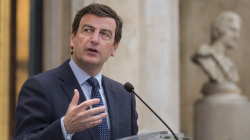
European Relations Minister Hamish Falconer addressed the Pontignano Conference in Rome on November 27th, 2026.
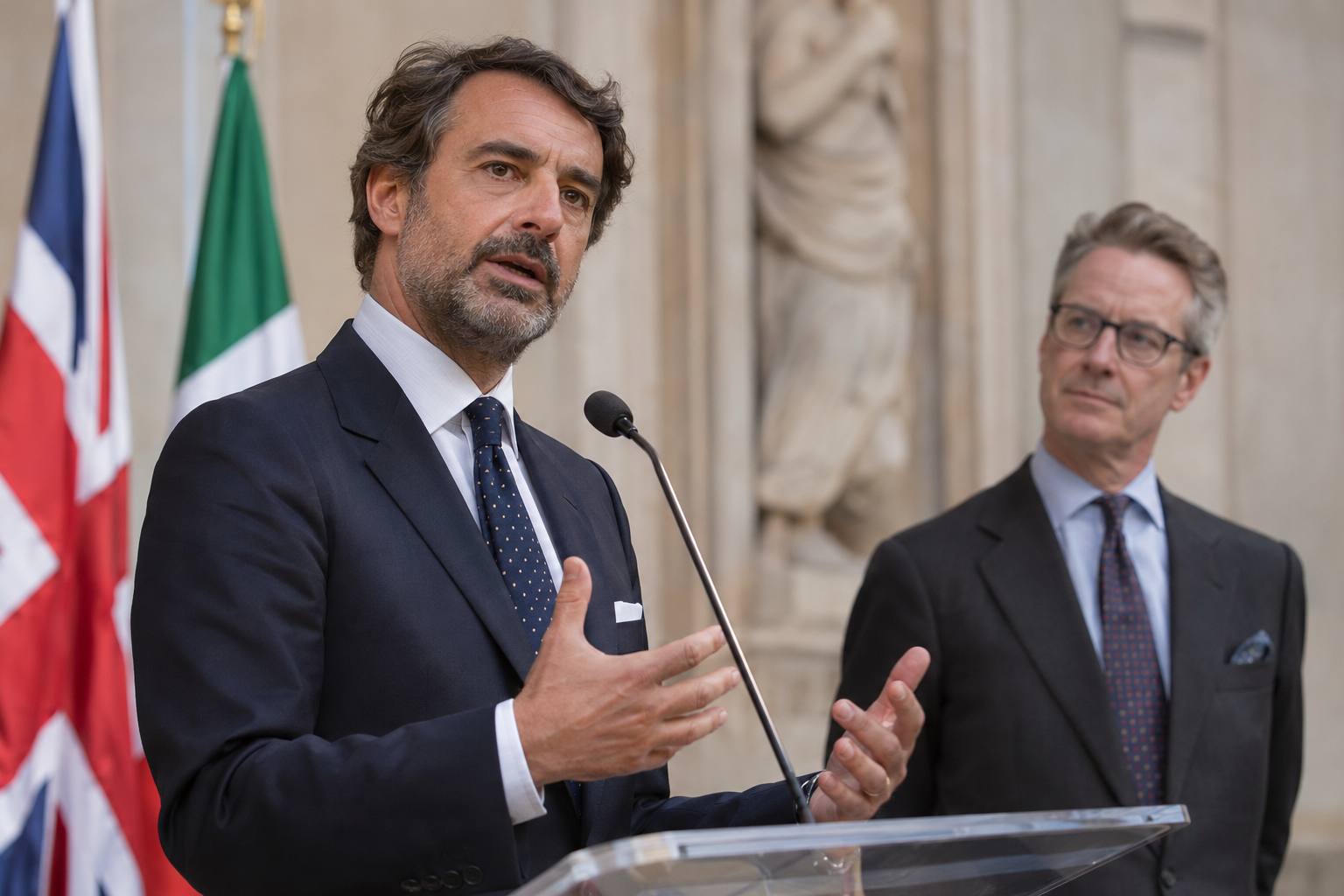
Falconer said it was an honour to join Italian and British friends at the event.
He began by speaking about the British Ambassador, Stephen, whom he had known for many years. The two had served as diplomats together before Falconer left the service to stand in an election.
Falconer joked that Stephen had secured more glamorous postings, including New York, while he had been sent to Juba. With what he described as the greatest respect for the South Sudanese, he said most people would consider Stephen to have received the better arrangement.
He added that Stephen had excelled himself by reaching the Villa Wolonsky in Rome. Falconer described Stephen, himself and the other attendees as extremely fortunate to be in the city. It was his second visit of the year, following a spring trip with his wife that he said had left him spellbound.
Reflecting on his diplomatic career, Falconer said the profession teaches two things, one more apparent than the other. The obvious lesson, he said, is how much diplomats learn about the countries where they visit and live.
He said understanding a country involves more than learning facts from Wikipedia, extending to how people drive, greet one another, disagree and conduct everything in between. According to Falconer, there is pleasure in each unfamiliar characteristic encountered abroad.
The less obvious lesson, he said, is discovering how strange Britain appears to other people.
Falconer said he did not need to attend the conference to understand how unusual Italians could find the British. The previous year’s conference was held in Siena, the hometown of his uncle Marco. Describing Marco as Sienese to his core, Falconer recalled being taken by him to the palio, eating at long tables alongside Marco’s friends and neighbours in his contrada, and observing how the city marked victories and defeats. He portrayed those experiences as an image of warmth and closeness.
He contrasted that setting with Marco’s first encounter with the Scottish Highlands, specifically the shores of Loch Ness, after marrying Falconer’s aunt. Instead of sitting together at a long table, neighbours could be a mile’s walk apart. Falconer also noted that the Scottish climate, as every Italian journalist had told him and Douglas that afternoon, was very different, as were British social manners.
He said the two countries express the warmth of their traditions in notably different ways.
Despite those differences, or perhaps because of them, Falconer said a profound connection exists between the countries. He recalled being with their two Prime Ministers when they met for the first time in Dublin.
He said the countries were already undertaking a substantial amount of important work together, while more remained to be done.
Falconer described their bilateral trade relationship as among Europe’s deepest and most dynamic.
During the last twelve months, he said, total trade between the United Kingdom and Italy had risen to over £52 billion. That made Italy the United Kingdom’s tenth-largest global trading partner and its eighth-largest partner for goods trade.
Although the relationship includes significant consumption of pizza and pasta, Falconer characterised it as a high-skilled, high-tech partnership. He noted that even in the country of Ferrari, Italy’s leading import from the UK was British cars, while some of the two countries’ most important industrial connections involved high-tech defence.
According to Falconer, anyone who had spoken with a business shipping goods across the English Channel, or managing a supply chain between Milan and Manchester, would recognise an uncomfortable reality.
For several years, he said, the United Kingdom had effectively been trading with one hand tied behind its back. He attributed this to a status quo that had not been working.
Falconer said the Prime Minister had spoken openly about Brexit, arguing that both Brexit and the manner of the United Kingdom’s departure from the European Union had caused more harm than good. He added that politicians had increasingly been more candid with the public on the subject.
He said many members of the public had already reached that view independently.
Falconer argued that Brexit had not eased living costs for working families. Instead, he said, it had made travel more difficult for individuals and businesses and created extensive new red tape that had damaged the economy.
He said British businesses, ranging from major supermarkets to small food producers, wanted to trade at the centre of Europe.
According to Falconer, Brexit had restrained those businesses by requiring burdensome documentation and costly checks before British produce could reach European shelves.
He referred to a conversation with the family operating Casa dei Latticini, who had complained about the increased difficulty of obtaining British Stilton and Cheddar and the greater expense involved in selling parmesan and mozzarella.
Falconer said the consequences went beyond inconvenience for businesses, identifying young people as some of Brexit’s major losers.
He said the United Kingdom now had its first generation of Britons since the 1970s without the right to live, work and study in Europe, opportunities their parents had regarded as routine.
As a result, he said, millions of people who were not old enough to vote a decade earlier had inherited the consequences.
Falconer described this as a shock for many families across the UK, although he said he was not surprised. In his assessment, the country had ultimately experienced a much harder Brexit than had been promised during the 2016 referendum.
At the same time, he said, international conditions had deteriorated.
Falconer described an era of growing conflict, geopolitical instability and economic uncertainty, circumstances he said Italy would understand particularly clearly as a member of the Coalition of the Willing.
In 2026, ten years after the referendum, he said developments across many areas demonstrated the critical value of deeper cooperation among close European allies.
He said those conditions had prompted the government to pursue a reset in relations with the EU.
Falconer said the two sides shared both priorities and challenges and would each benefit from resetting their relationship.
He presented the agreement negotiated at the United Kingdom–European Union Summit the previous week as a landmark development.
In Falconer’s account, the agreement represented a win for both Britain and Europe.
He said it would lower costs, reduce red tape and provide opportunities for young people.
He also said it fulfilled the government’s commitment to develop a closer and more pragmatic relationship between the UK and the European Union.
According to Falconer, the agreement moved the relationship significantly closer to what the British public had been promised a decade earlier.
He said it did so while observing the clear red lines contained in the government’s manifesto.
Falconer characterised the measures as practical and concrete changes capable of affecting people’s lives, rather than minor adjustments.
He then outlined what the measures would mean in practice and why they mattered to the respective economies.
First, he said, the agreement would reduce business costs and help restrain prices by removing post-Brexit checks on food and agricultural exports.
Falconer said few countries understood the cultural and economic importance of food and drink more clearly than Italy.
He noted that the United Kingdom imported billions of pounds of Italian produce each year, while British producers, including Scottish salmon farmers and West Country cheesemakers, took pride in selling products throughout Europe.
Since 2023, however, British companies had been required to purchase more than 1 million multi-page Export Health Certificates to trade with the EU, at a cost of up to £217 million, Falconer said.
He said the agreement would save a British company up to £200 in paperwork each time it sold agri-food products into Europe.
When full physical sampling costs were included, he added, the burden had been still greater.
According to Falconer, the required stamps could cost £1,200 for a load of British cheese sold overseas and £1,400 for a shipment of British salmon.
He said the change was not solely intended to hold down prices on supermarket shelves in London and Rome. It would also, he argued, make supply chains more efficient for Italian importers and lessen delays at ports.
Falconer said the agri-food agreement alone would contribute up to £5.1 billion annually to the British economy. Turning to a second measure, he said the government would reduce red tape for heavy industry and clean energy by connecting the UK Emissions Trading Scheme with the EU’s system.
He described the United Kingdom and Italy as global leaders in the shift to clean power and said their industrial sectors were closely connected.
Total goods trade between the two countries was over £33 billion, Falconer said, supported by energy-intensive industries including steel, aluminium, automotive manufacturing and advanced machinery.
By connecting the emissions trading schemes, he said, the UK and EU would be exempted from one another’s Carbon Border Adjustment Mechanisms.
Falconer said this measure would exempt around £6.5 billion in British exports, including steel and aluminium, from EU carbon taxes. He added that it would maintain seamless trade for Italian manufacturers importing British components.
He said the measure would reduce red tape in developing green industries such as carbon capture and storage and provide a less expensive, more predictable route to net zero.
By 2040, Falconer said, this linkage alone would contribute up to £3.8 billion annually to the British economy while offering numerous benefits to Italian importers.
In what he described as a critically important field of industrial cooperation, Falconer said the parties had nearly committed themselves not to harm one another. He expressed hope that this would reassure the many businesses investing across Europe that did not want new initiatives to fragment the continent’s supply chains and industrial base.
His third point, which he described as perhaps closest to the spirit of Pontignano, concerned new opportunities for young people.
Falconer said the conference had always focused on investment in the next generation of British and Italian leaders.
For decades, he said, young people from Britain and Italy had contributed to one another’s universities, laboratories, studios and workplaces.
As he had noted earlier, Falconer said that bridge had been damaged since Brexit.
He said the Youth Experience Scheme would restore the connection by allowing up to 100,000 young people from the two sides to live, work or study in each other’s countries.
Falconer expressed personal enthusiasm for the measure and said he believed the agreement would help make that place still more vibrant.
He characterised it as a genuine mutual benefit for young people in Britain and Europe, while maintaining that the United Kingdom would retain firm control over its immigration system.
Collectively, Falconer said, the agreement fulfilled a shared commitment to a closer and stronger partnership with the EU.
Along with economic growth, he said, the Summit had established a basis for greater cooperation on matters important to both parties. These included addressing irregular migration, breaking up criminal smuggling gangs, limiting energy costs and defending the continent as the world became increasingly dangerous.
Falconer said the agreement represented the foundation for the government’s ambitions, rather than their upper limit.
He concluded by focusing on the opportunities he said it created.
Falconer said conferences such as Pontignano offered a chance to shape diplomatic relationships and consider how shared challenges could be overcome collectively.
For an extended period, he said, the UK/EU partnership had been hindered by a status quo that benefited no one.
He said the two sides now faced a considerably more collaborative future.
While preparing for the previous week’s Summit and completing the agreement, Falconer said those involved had settled on a straightforward test.
That test was whether the agreement improved life for ordinary people in the UK and throughout Europe.
He pointed to businesses that he said would avoid millions of pounds in unnecessary paperwork, industries protected against new tariffs, families insulated from higher food prices and tens of thousands of young people who would again be able to establish their futures across the continent.
On that basis, Falconer said he had no doubt that the answer was a resounding “yes”.
He then put another question to those attending the conference: how the agreement reached the previous week could be developed further, and how that work could be undertaken with friends in Italy.
Falconer said he looked forward to finding the answer with those present over the coming years.
Based on a UK GOV.UK statement · Read the original ↗